Update: Railway's full incident report
Updated November 14, 2026. Railway published its full incident report on November 10. The key findings:
- The attacker decrypted a subset of customer variables for at most 1.85% of workspaces (about 100,000). Railway's logs identify environments rather than individual variables, so this is an upper bound.
- AI provider keys were the main target, believed to be resold for model distillation. Railway estimates about $740,000 of unauthorized spend. Cloud, database and payment credentials were also taken in some cases.
- The attacker also obtained stored histories of 353 builds (including sealed variables), a copy of Railway's internal monorepo, and linked-account tokens (GitHub OAuth and bring-your-own agent keys) for 1,852 users, all of which were reset.
- Railway says it found no sign that customer repositories were downloaded or customer databases accessed.
- Root cause: a previously unknown escape in the multi-tenant build infrastructure gave the attacker a build credential, which an internal service trusted. A misconfigured cloud identity binding then led to a machine holding a long-lived decryption credential.
If you have unexplained charges, use the claim form in Railway's report. Some AI providers are refunding fraud; Railway says it is covering Anthropic and OpenRouter costs itself. Rotating every secret is still the right call: an upper bound of 100,000 workspaces is not a list you can check yourself against.
Overview
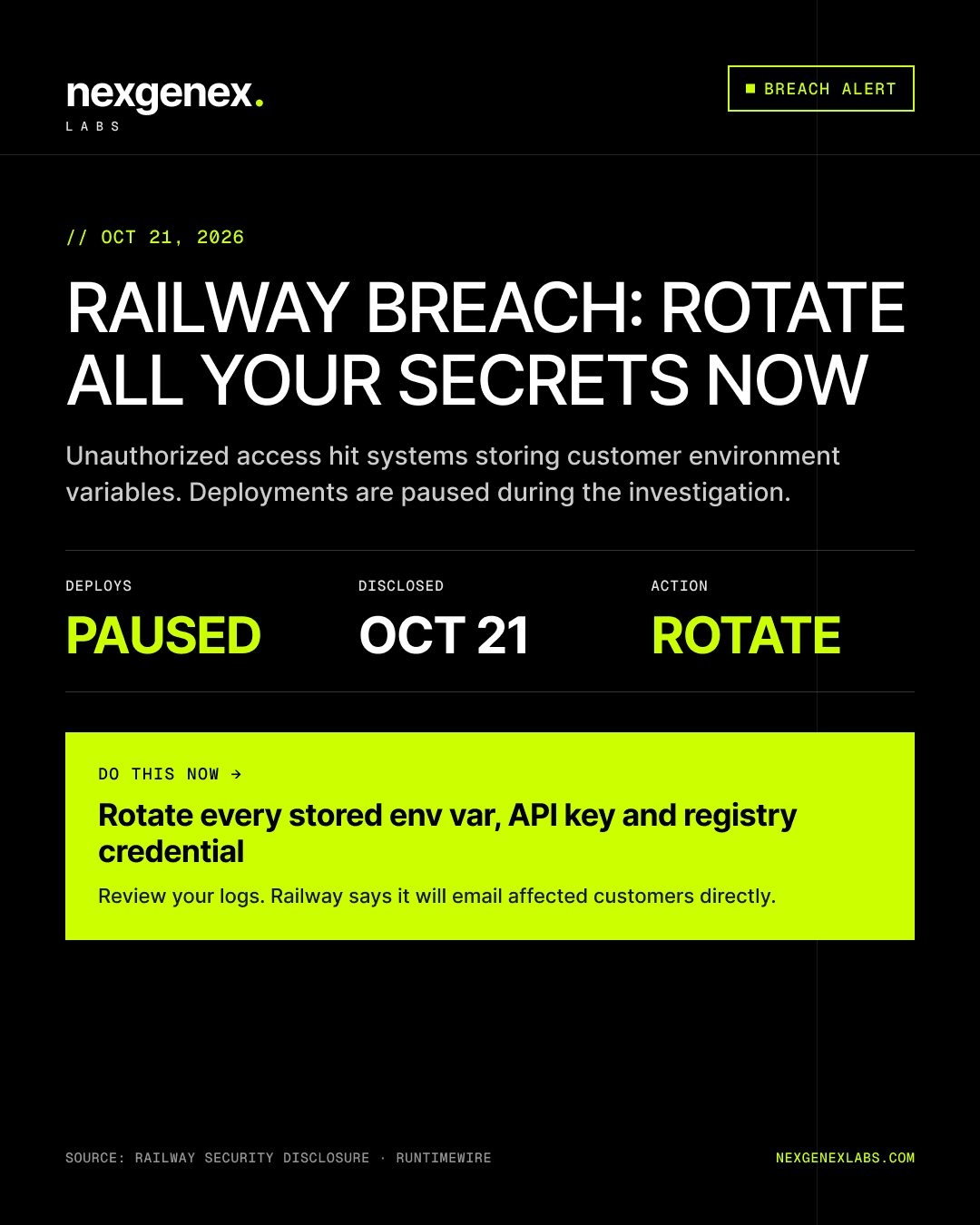
On October 21, 2026, the deployment platform Railway disclosed a security incident involving the systems that store customer environment variables. If you host anything on Railway, stop reading and start rotating credentials. Then come back for the details.
What Railway said on October 21
According to Railway's own disclosure:
- It detected anomalous activity in systems that store customer environment variables earlier on October 21.
- An unauthorized third party may have accessed encrypted environment variables, and for some, obtained the decrypted contents. These may include API keys and database or registry credentials.
- Initial analysis suggests the impact may be limited to a subset of users, but Railway has not confirmed which accounts were affected. It says it will email affected customers directly.
- Railway believes this is part of a series of recent attacks on platform companies aimed at compromising AI inference providers, and has asked upstream providers to proactively revoke keys.
- All deployments are paused during the investigation. Users cannot roll out new versions until builds are restored.
- The investigation is ongoing, so these findings are preliminary.
These were the preliminary findings. The full report of November 10 (above) confirms the scope.
Why "only a subset" is not a reason to wait
Because Railway has not said which accounts are affected, the safe assumption is that yours might be. Environment variables are where teams keep their most powerful credentials: database URLs, payment keys, cloud tokens, AI provider keys. A leaked key does not expire on its own, and an attacker does not need to touch your infrastructure again once they hold it.
Railway itself recommends that all users act.
What to rotate
Work through this list in order of blast radius:
- 01Database credentials and connection strings for anything your Railway services connect to.
- 02Cloud and infrastructure keys (AWS, GCP, Azure, storage buckets, CDNs).
- 03AI and third-party API keys, especially LLM providers, payment processors, email and SMS providers.
- 04Signing and session secrets such as JWT secrets, cookie secrets and webhook signing keys. Rotating these will log users out, which is the point.
- 05Private registry credentials, which Railway specifically calls out.
- 06Anything shared: if the same key lives in other tools, CI or your local
.envfiles, rotate it everywhere.
Rotate at the provider, not just in Railway. Updating the value in your Railway dashboard does nothing if the old key remains valid at the source. Revoke the old key, issue a new one, then update Railway.
Then check for misuse
- Review logs for the affected services for unusual activity.
- Check your providers' audit logs for key usage from unfamiliar IPs or regions, and for unexpected spikes in billing or API usage (a common sign of stolen AI and cloud keys).
- Make sure deployments, CI/CD and integrations still work with the new values once Railway restores builds. Railway will post updates on its announcement and at status.railway.com.
The bigger lesson
Any platform that stores your secrets is part of your attack surface. A few habits make incidents like this far less painful:
- Keep an inventory of every secret, where it lives and who owns it, so a "rotate everything" day takes an hour, not a week.
- Prefer short-lived, scoped credentials over long-lived admin-level keys.
- Set spend limits and alerts on AI and cloud accounts.
- Practice rotation before you need it. If rotating a key breaks production, find that out on a quiet Tuesday.
How NexGenex Labs can help
We help teams build secrets-management and incident-response playbooks, and can assist with an urgent credential audit. Get in touch.
Sources
Have a project like this in mind?
Talk To Our Team →